Poly B vs PEX: Complete Edmonton Homeowner’s Guide
If you have an older Edmonton home with grey flexible plumbing, you may be wondering about Poly B vs PEX and whether your existing plumbing should be replaced.
Poly B and PEX can look similar at first glance, especially when homeowners encounter grey flexible tubing underneath a sink, in a basement ceiling, or near a water heater. However, they are different plumbing materials with different histories, markings, installation methods, and considerations for today’s homeowner.
Understanding Poly B vs PEX is particularly important if you own or are purchasing a home built during the 1980s or 1990s, are planning a renovation, or have discovered a combination of older and newer plumbing materials.
This guide explains the differences between Poly B and PEX, how to identify each material, why many Edmonton homeowners consider replacing Poly B, what PEX replacement involves, and what you should know before making a decision.
What Is Poly B?
Poly B is short for polybutylene, a flexible plastic piping material that was used for residential potable-water distribution.
In Alberta, Poly-B was introduced to the construction industry in the mid-1970s and was used in residential and commercial buildings for more than 20 years. Alberta’s published safety information states that manufacturers stopped producing Poly-B piping in 1998.
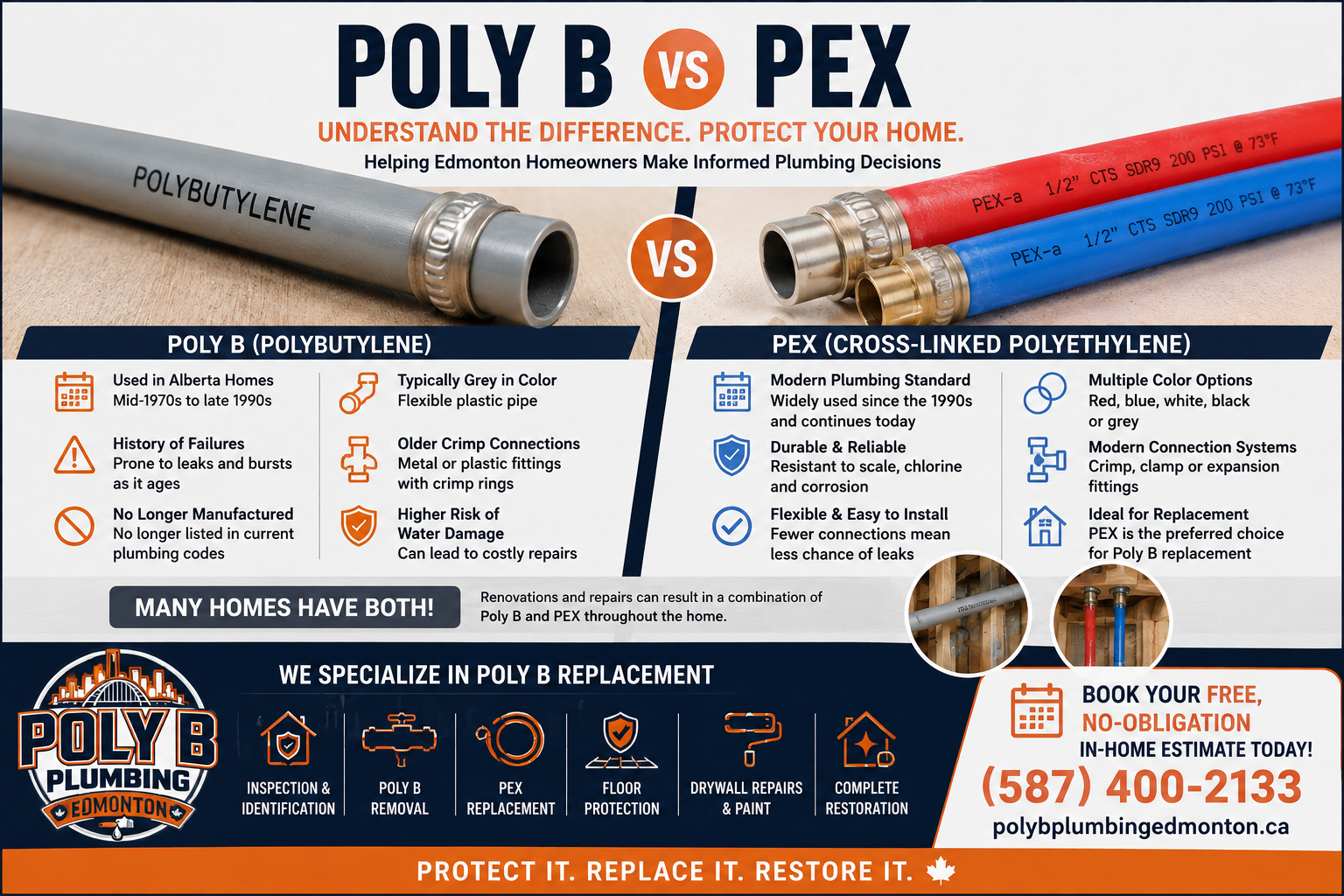
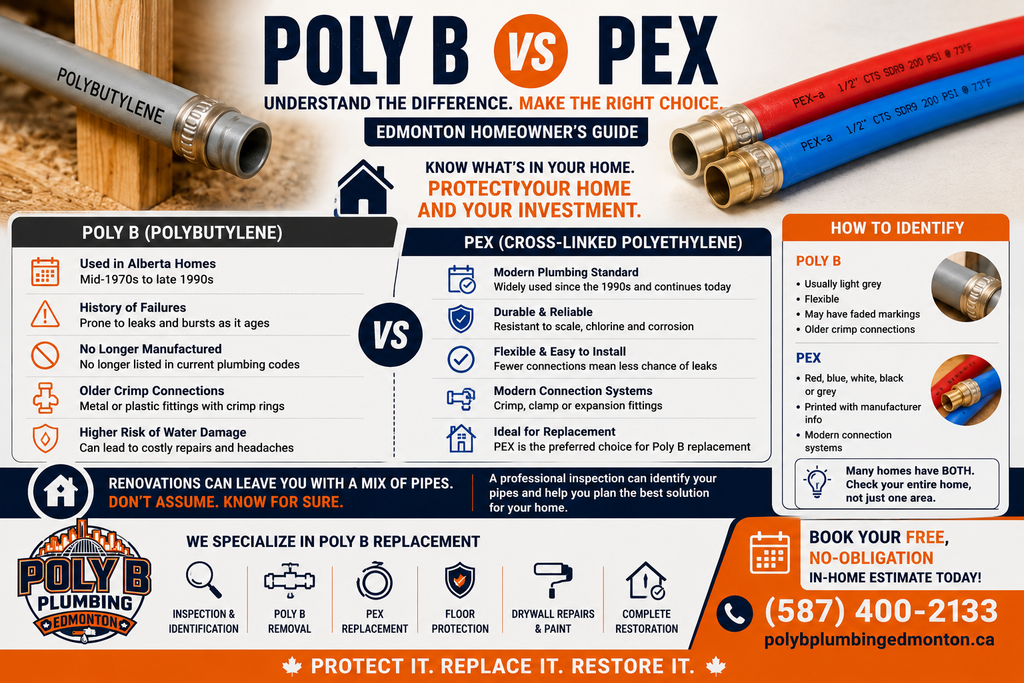
Poly B is commonly identified by its light-grey colour and flexible construction. The pipe can also contain printed markings that identify its size, manufacturer, material designation, pressure rating, certification information and applicable standards.
The important point when comparing Poly B vs PEX is that Poly B is an older plumbing material that homeowners may still find in existing homes even though it is no longer being manufactured.
What Is PEX?
PEX stands for cross-linked polyethylene.
It is a flexible plastic tubing material commonly used in modern residential water-distribution systems.
PEX is available in several colours, including:
- Red
- Blue
- White
- Black
- Grey
- Other manufacturer-specific colours
Red and blue PEX are commonly used to help distinguish hot and cold water lines, although colour itself is not a technical requirement for identifying PEX.
PEX also commonly has extensive printing along the tubing. The markings can identify the manufacturer, tubing size, pressure rating, applicable standards and other product information.
When looking at Poly B vs PEX, homeowners should therefore consider the pipe’s markings, fittings, installation age and overall appearance rather than relying only on colour.
Poly B vs PEX: What’s the Biggest Difference?
The simplest way to understand Poly B vs PEX is to look at their age, material characteristics, markings and intended use in today’s residential plumbing.
Poly B
Poly B is generally:
- Light grey
- Flexible
- Associated with older installations
- Commonly found in homes built during the 1980s and 1990s
- Identifiable through specific pipe markings
- Found with older-style fittings
- No longer manufactured
PEX
PEX is generally:
- Flexible
- Available in multiple colours
- Common in modern residential plumbing
- Clearly marked by the manufacturer
- Available in different sizes
- Installed using modern connection systems
- Widely used for replacement plumbing
This is why homeowners comparing Poly B vs PEX should look beyond the colour of the tubing.
Is Grey Pipe Poly B or PEX?
This is one of the most common questions homeowners ask.
The answer is: it could be either.
Grey Poly B is common, but grey PEX also exists.
If you find grey flexible tubing in your basement, under a sink or around your water heater, don’t automatically assume it is Poly B.
Instead, inspect the printing on the tubing.
Look for:
- Manufacturer information
- Material designation
- Product standards
- Size
- Pressure rating
- Date information
- Other identifying markings
If the markings are difficult to read, take clear photographs and have the material professionally identified.
This is one of the most important lessons when learning about Poly B vs PEX.
How Can You Identify Poly B?
Several characteristics can help identify Poly B.
Start by checking the age of the home.
Homes constructed during the 1980s and 1990s deserve particular attention because Poly B was widely used during that period.
Next, inspect accessible plumbing.
Look for light-grey flexible pipe in:
- Unfinished basements
- Mechanical rooms
- Under kitchen sinks
- Under bathroom sinks
- Laundry rooms
- Around water heaters
- Near the main water entry
- Between basement ceiling joists
Then inspect the markings.
Poly B may have printed markings that help identify the material.
Fittings can also provide useful clues.
However, no single characteristic should necessarily be used by itself to make a final determination.
How Can You Identify PEX?
PEX is also flexible, which is why it can sometimes be confused with Poly B.
Look for the following:
- Red, blue, white, black or grey tubing
- Manufacturer printing
- PEX-related material identification
- Modern connection systems
- Product size and pressure markings
- Installation associated with newer renovations
If a bathroom was renovated recently, for example, the plumbing underneath the vanity may contain PEX.
That does not necessarily tell you what is installed elsewhere in the house.
Can a Home Have Both Poly B and PEX?
Absolutely.
This is extremely common in older Edmonton homes.
A homeowner may renovate a bathroom and have the plumbing replaced with PEX while leaving Poly B throughout the rest of the house.
The same situation can happen during:
- Kitchen renovations
- Basement renovations
- Water heater replacements
- Plumbing repairs
- Leak repairs
- Fixture replacements
- Bathroom renovations
This creates one of the biggest misunderstandings when comparing Poly B vs PEX.
Seeing PEX in one area does not prove that the entire home has been repiped.
Why Partial PEX Replacement Can Be Misleading
Imagine you purchase a 1990s Edmonton home.
The previous owner renovated the ensuite.
Under the vanity, you see modern PEX.
You assume the plumbing has been completely replaced.
Later, you enter the unfinished basement and notice grey flexible tubing running between the floor joists.
That grey pipe may be the original Poly B system supplying other areas of the house.
The renovated bathroom may have been repiped while the rest of the plumbing remained unchanged.
This is why homeowners should evaluate the entire water-distribution system when deciding between continuing with an existing system and planning Poly B replacement.
Poly B vs PEX: Fittings
The fittings can provide another clue.
Older Poly B installations commonly used connection methods involving crimp rings and fittings that may be made from different materials depending on the installation.
PEX can also be installed using crimp-style connection systems.
Because both materials can have crimp connections, the fitting alone does not necessarily prove whether the tubing is Poly B or PEX.
This is another reason the comparison of Poly B vs PEX should consider multiple characteristics together.
Look at:
- Pipe colour
- Pipe flexibility
- Printed markings
- Fitting type
- Installation age
- Location
- Other plumbing materials connected to the system
If you’re still uncertain, have the material professionally confirmed.
Poly B vs PEX: Appearance
Appearance can be helpful, but it should not be the only identification method.
Poly B Appearance
Poly B is commonly:
- Light grey
- Smooth
- Flexible
- Plastic
- Used for potable-water distribution
PEX Appearance
PEX may be:
- Red
- Blue
- White
- Black
- Grey
- Flexible
- Smooth
The presence of grey tubing therefore does not automatically identify Poly B.
When comparing Poly B vs PEX, the markings printed along the tubing are often more useful than colour alone.
Poly B vs PEX: Age of Installation
The age of the plumbing system is another useful clue.
If you have a home constructed in the 1980s or 1990s, Poly B should be considered during a plumbing inspection.
If a section of plumbing was installed during a recent renovation, PEX may be more likely.
However, renovations can create mixed systems.
A home built in 1990 could contain:
- Original Poly B
- New PEX
- Copper
- Brass fittings
- Stainless-steel supply lines
- Other plumbing materials
Therefore, the home’s construction date is a starting point rather than definitive proof.
Why Are Edmonton Homeowners Replacing Poly B With PEX?
The Alberta government has published information documenting a history of Poly-B pressure-water-piping failures and states that Poly-B is no longer listed in current plumbing codes. It also notes that plumbing codes are not retroactive.
That does not mean every Poly B system will fail or that a homeowner should panic after discovering it.
Instead, the decision should be based on the specific home’s plumbing system, condition, age, accessibility, insurance considerations and long-term plans.
For homeowners who decide to remove Poly B, PEX is one common modern replacement option.
Is PEX Better Than Poly B?
When discussing Poly B vs PEX, it’s important to avoid oversimplifying the answer.
PEX is a modern plumbing material widely used in residential water-distribution systems.
Poly B is an older material that is no longer manufactured.
For a homeowner planning to replace an existing Poly B system today, PEX may be one of the replacement materials considered by a qualified plumbing professional.
The appropriate tubing and connection system should be selected based on the home’s layout, applicable plumbing requirements and project scope.
What Happens During a Poly B to PEX Replacement?
A complete replacement can involve several stages.
Step 1: Inspection
The contractor identifies accessible Poly B and determines how much of the system appears to remain.
Step 2: Project Planning
The plumbing layout is reviewed and the best routing for the replacement system is determined.
Step 3: Home Protection
Floors, cabinets, furniture and other finished surfaces near the work area are protected.
Step 4: Access
The contractor determines where access is needed to reach concealed sections of the existing plumbing.
Step 5: Poly B Removal
The existing Poly B is removed from the areas included in the project.
Step 6: PEX Installation
New PEX tubing is installed according to the planned plumbing layout and applicable requirements.
Step 7: Testing
The replacement plumbing is tested before the project is completed.
Step 8: Restoration
Where required, affected drywall, paint and texture can be repaired and restored.
A professional replacement project should therefore be viewed as a complete home-plumbing project rather than simply swapping one type of pipe for another.
Does Replacing Poly B With PEX Require Opening Walls?
Not necessarily.
Some homes have extensive accessible plumbing in unfinished basements or mechanical areas.
Other homes have plumbing concealed behind:
- Drywall
- Finished ceilings
- Flooring
- Cabinets
- Bulkheads
- Other finished surfaces
The amount of access required depends heavily on the home’s design.
This is why an in-home assessment is useful when discussing Poly B vs PEX and the cost of a potential replacement.
How Much Does Poly B to PEX Replacement Cost in Edmonton?
There is no universal price.
Every home has a different plumbing layout and different access requirements.
Factors that can affect the cost include:
- Home size
- Number of bathrooms
- Number of fixtures
- Number of floors
- Basement configuration
- Accessibility
- Finished ceilings
- Finished walls
- Flooring
- Cabinets
- Plumbing layout
- Amount of Poly B remaining
- Drywall repairs
- Paint and texture restoration
- Project scope
- Replacement material
A bungalow with an unfinished basement can have very different access requirements from a two-storey home with finished ceilings and several bathrooms.
For that reason, online estimates should be treated as general information.
The best way to understand the cost of your project is to have your home assessed.
Should You Replace Poly B If It Has Never Leaked?
There isn’t one universal answer.
Some homes have had Poly B for decades without experiencing a major leak.
However, the absence of a previous leak does not guarantee that the plumbing will never experience a problem.
Homeowners should consider:
- Age of the plumbing
- Condition of accessible pipe
- Amount of Poly B remaining
- Insurance requirements
- Future renovation plans
- Plans to sell the property
- Potential water-damage consequences
- Cost of replacement
A professional plumbing assessment can help you make an informed decision.
Poly B vs PEX and Home Insurance
Insurance requirements can vary between companies and properties.
If you’re purchasing an Edmonton home with Poly B, speak directly with your insurance provider about the specific property.
Do not assume that another homeowner’s insurance policy will automatically apply the same way to you.
If you complete a replacement, keep your project documentation.
Useful records can include:
- Invoices
- Written scope of work
- Completion documentation
- Permits where applicable
- Information about the replacement plumbing
- Warranty information
Documentation can be useful when selling the property or discussing the plumbing system with an insurer.
Should You Replace Poly B Before Selling Your Edmonton Home?
Some homeowners choose to replace their Poly B before listing their property.
Others wait until a buyer’s inspection identifies the plumbing.
There are advantages and disadvantages to both approaches.
Replacing before listing can allow the seller to control the project and provide documentation to prospective buyers.
However, the cost and return on investment should be carefully considered.
If you’re selling a home with Poly B, obtaining a professional assessment and replacement estimate can help you understand your options.
Should You Replace Poly B Before Buying an Edmonton Home?
If you’re purchasing a home and discover Poly B, don’t automatically assume you should walk away.
Instead, determine the actual scope of the plumbing.
Ask:
- How much Poly B remains?
- Where is it located?
- Has any of the plumbing already been replaced?
- Is PEX already present?
- How accessible is the existing system?
- What restoration may be required?
- What is the estimated replacement cost?
- What does your insurance provider require?
A professional estimate can give you information that may help with your purchase decision or negotiations.
Why Professional Identification Matters
The comparison of Poly B vs PEX can seem straightforward when looking at photographs online.
In real homes, however, plumbing systems can be complicated.
You may encounter:
- Grey PEX
- Grey Poly B
- Copper
- CPVC
- Brass
- Stainless-steel supply lines
- Mixed plumbing systems
- Previous repairs
- Partial repiping
This is why homeowners should avoid making a major replacement decision based solely on pipe colour.
If you’re uncertain, have the accessible plumbing professionally evaluated.
Poly B vs PEX: Quick Comparison
| Feature | Poly B | PEX |
|---|---|---|
| Material | Polybutylene | Cross-linked polyethylene |
| Appearance | Commonly grey | Red, blue, white, black, grey and other colours |
| Flexibility | Flexible | Flexible |
| Common era | Older installations | Modern installations |
| Markings | Manufacturer/material markings | Extensive manufacturer/product markings |
| Current manufacturing | No longer manufactured | Widely manufactured |
| Typical homeowner concern | Aging existing systems | Common modern replacement material |
| Replacement consideration | Often evaluated for replacement | Common replacement option |
The table provides a quick overview, but the actual plumbing system should be professionally evaluated when identification is uncertain.
Frequently Asked Questions
Is Poly B the same as PEX?
No. Poly B and PEX are different plastic piping materials. They can look similar because both are flexible, which is why identifying the markings and installation characteristics is important.
Is grey PEX the same as Poly B?
No. Grey PEX exists, but it is a different material from Poly B.
Can PEX connect to Poly B?
Appropriate transition fittings and installation methods can be used when transitioning between different plumbing materials. The connection should be completed using fittings suitable for the specific materials involved.
Can I have Poly B and PEX in the same house?
Yes. Partial renovations and repairs can result in a home containing both materials.
Does seeing PEX mean my house has been completely repiped?
No. PEX in one bathroom or kitchen does not prove that Poly B has been removed throughout the entire home.
Is PEX a common replacement for Poly B?
Yes. PEX is one of the common modern replacement options considered for residential water-distribution systems.
How do I know if my grey pipe is Poly B?
Inspect the pipe markings, fittings, installation age and location. Because grey PEX also exists, colour alone is not enough to identify the material.
Does Poly B need to be replaced if it hasn’t leaked?
There is no universal answer. Homeowners should consider the age and condition of the system, how much remains, insurance considerations and the potential consequences of future failure.
How long does a Poly B to PEX replacement take?
The project timeline depends on the size and layout of the home, the amount of Poly B remaining, accessibility and restoration requirements. An in-home assessment is needed for a realistic project estimate.
The Bottom Line: Poly B vs PEX
When comparing Poly B vs PEX, the most important thing to understand is that they are different plumbing materials and that a home’s plumbing system may contain both.
Poly B is commonly found in older Edmonton homes and can often be identified by its light-grey flexible appearance, markings and older installation characteristics.
PEX is a modern flexible plumbing material available in multiple colours and widely used in residential water-distribution systems.
If your home contains Poly B, you do not necessarily need to panic.
Start by determining how much Poly B remains and where it is located.
Then consider the condition of the system, insurance requirements, your plans for the property and the potential cost of replacement.
If you decide that replacing the older plumbing makes sense, PEX may be one of the replacement options available for your home.
professional Poly-B replacement services
If your research has led you to consider replacing your Poly-B plumbing, learn more about our professional Poly-B replacement services in Edmonton.
Poly-B FAQ
Still have questions? Visit our Poly-B FAQ for answers to common homeowner concerns.
our Poly-B plumbing experience
Learn more about our Poly-B plumbing experience and our complete start-to-finish approach.
Free Poly-B replacement estimate
If you’re ready to find out what replacement could look like for your home, request a free Poly-B replacement estimate.
Need Help With Poly B vs PEX in Edmonton?
Poly B Plumbing Edmonton specializes in Poly B identification, replacement and complete plumbing remediation throughout Edmonton.
Our team can help determine whether the plumbing you have is Poly B, PEX or a combination of materials and explain your replacement options.
Services include:
- Poly B identification
- Poly B assessments
- Complete Poly B removal
- PEX repiping
- Floor protection
- Drywall repairs
- Paint and texture restoration
- Complete plumbing remediation
Free In-Home Estimate
If you’re unsure whether your home has Poly B or you’re considering replacing it with PEX, schedule a free, no-obligation in-home estimate.
We’ll assess the accessible plumbing, discuss the project scope and provide a clear estimate for your property.
Poly B Plumbing Edmonton
Call: (587) 400-2133
Website: polybplumbingedmonton.ca
Protect It. Replace It. Restore It.