Poly B Failure Rate: What Edmonton Homeowners Need to Know
If you have Poly B plumbing in your Edmonton home, one of the first questions you may ask is: What is the Poly B failure rate?
Homeowners often find conflicting information online. Some websites claim that Poly B has a 100% failure rate, while other sources point out that many Alberta homes with Poly B have never experienced a major leak.
The truth is more complicated than a single percentage.
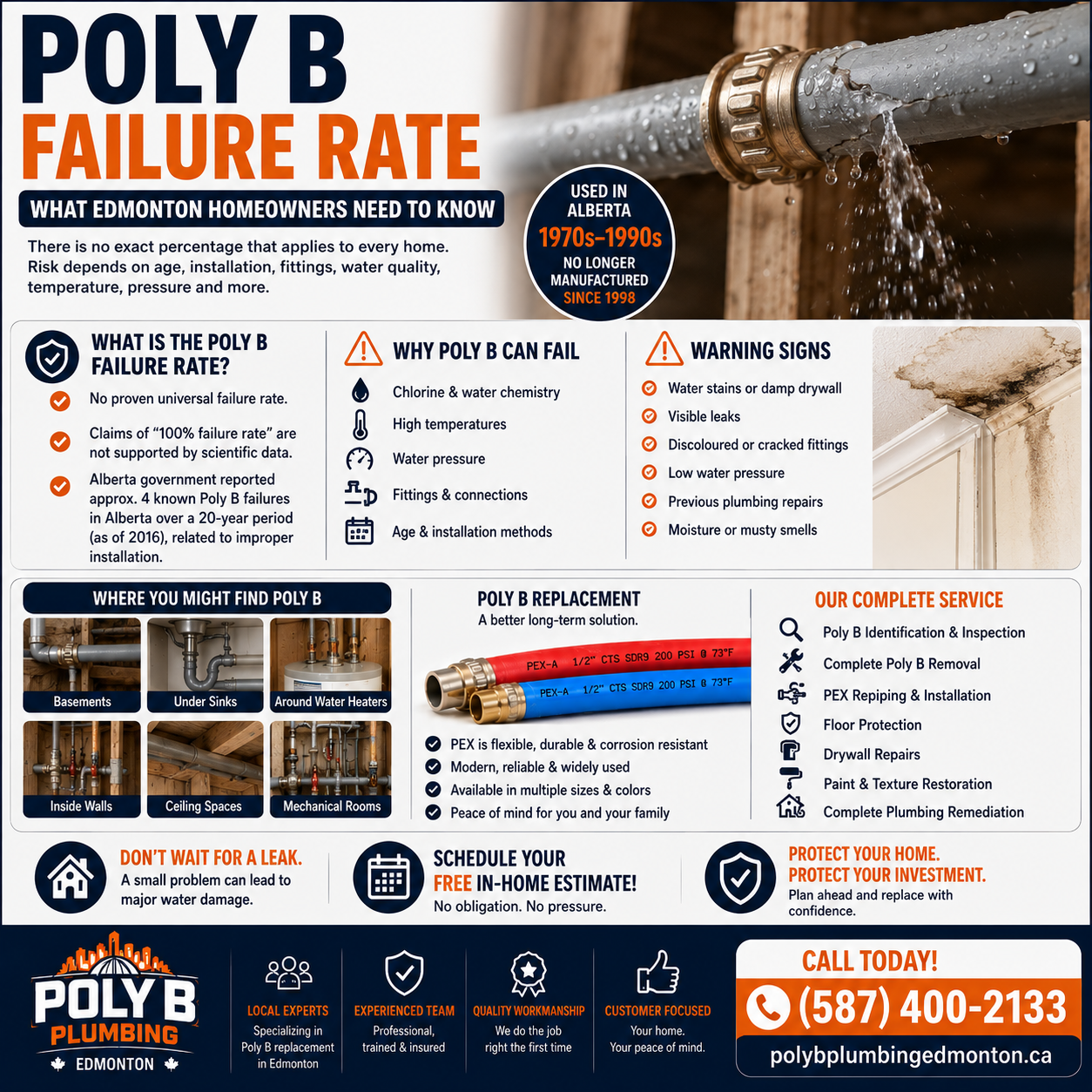
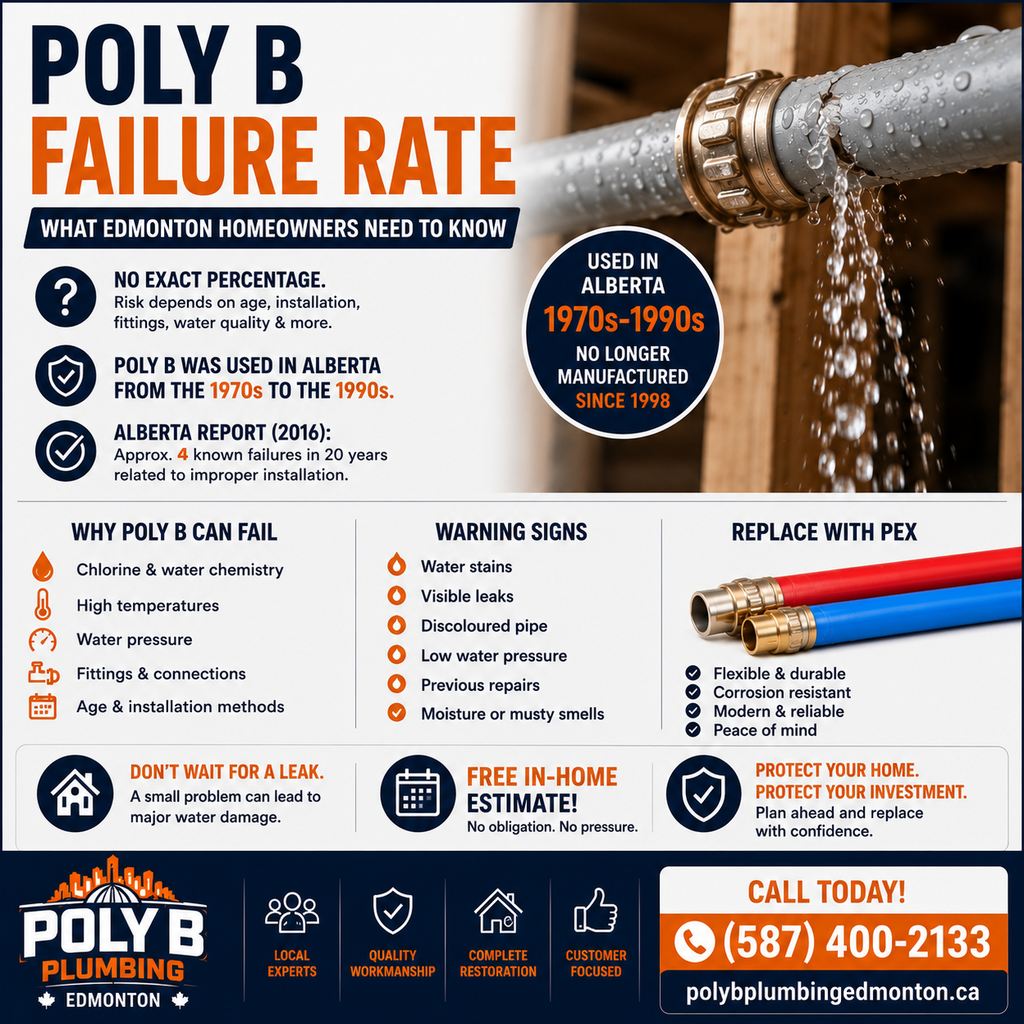
There is no reliable universal Poly B failure rate that can predict exactly when a particular home will experience a plumbing failure. The risk can depend on factors such as the age of the plumbing, installation methods, fittings, water conditions, temperature, pressure, and the specific Poly B system installed.
For Edmonton homeowners, understanding these factors is much more useful than relying on a simple percentage.
What Is Poly B?
Poly B, short for polybutylene, is a flexible plastic water-supply piping material that was widely used in residential construction.
In Alberta, Poly B was introduced to the construction industry in the mid-1970s and was used for more than 20 years. Manufacturers stopped producing Poly B piping in 1998.
Poly B is commonly light grey and flexible. It can be found in basements, mechanical rooms, under sinks, around water heaters, inside walls, above ceilings, and throughout residential water-distribution systems.
Because much of the plumbing is hidden, homeowners may not know they have Poly B until a home inspection, renovation, plumbing repair, or leak exposes it.
What Is the Poly B Failure Rate?
This is where homeowners need to be careful.
There is no scientifically established percentage that accurately tells us what percentage of all Poly B systems will eventually fail.
Some companies and industry sources describe Poly B as having a “100% failure rate.” However, this should not be treated as a proven statistical failure rate for every Poly B installation.
Alberta-specific information provides important context. Alberta Municipal Affairs reported approximately four known Poly-B failures in Alberta over a 20-year period as of 2016 and stated that those cases were related to improper installation rather than the material itself.
At the same time, Poly B has a documented history of failures in Canada and the United States, and concerns about the material contributed to its eventual discontinuation.
The most accurate conclusion is that there is no single failure percentage that can predict when a specific Poly B plumbing system will fail.
Why Do Some Websites Say the Poly B Failure Rate Is 100%?
You may have searched for “Poly B failure rate” and seen websites claiming that the failure rate is 100%.
This claim is often used by plumbing companies and industry sources to communicate that Poly B should not be considered a permanent long-term plumbing solution.
However, this is different from saying that scientific research has established that 100% of every Poly B installation will eventually leak.
Failure can vary between installations depending on factors such as:
- Pipe manufacturing
- Installation quality
- Fittings
- Water chemistry
- Temperature
- Pressure
- Age
- Exposure to heat
- Previous repairs
- Installation environment
Homeowners should therefore be cautious about websites that promise an exact Poly B failure percentage.
Does Poly B Eventually Fail?
Poly B has a documented history of premature failures.
Several factors can contribute to deterioration and plumbing problems. A section of pipe can sometimes appear normal from the outside while its internal condition may be different.
This makes visual inspection alone imperfect.
A Poly B system can be several decades old while still appearing relatively normal in accessible areas.
That does not necessarily mean the entire system is in perfect condition.
If you are concerned about the age and condition of your plumbing, a professional assessment can help you understand what is actually installed in your home.
Why Does Poly B Fail?
There are several factors that can contribute to Poly B deterioration or plumbing failures.
Chlorine and Water Chemistry
Water chemistry has been associated with Poly B degradation.
Municipal water supplies can contain disinfectants, including chlorine. Over time, exposure to water chemistry can contribute to changes in some polybutylene piping systems.
The impact can vary depending on the specific system and environment.
Temperature
Temperature can also affect plumbing materials.
Hot-water applications can place additional stress on plumbing systems, making the condition of Poly B used in these applications an important consideration.
Water Pressure
Water pressure can affect the stress placed on a plumbing system.
Higher water pressure can increase stress on pipes and connections. While this is not unique to Poly B, pressure is an important factor when evaluating any residential plumbing system.
Fittings and Connections
The fittings are another important part of the plumbing system.
A water-distribution system contains more than just pipe. It also includes fittings, crimp rings, connections, valves, transitions, and fixtures.
The type and condition of these components can affect the overall plumbing system.
This is one reason it is inaccurate to assume that every Poly B installation has exactly the same risk.
Can Poly B Look Fine and Still Have Problems?
Yes.
This is one of the biggest challenges with older Poly B plumbing.
A pipe may look clean and intact on the outside with no visible leak, water stain, discoloration, or obvious cracking.
However, that does not necessarily tell you everything about the condition of the plumbing system.
Some deterioration can occur internally.
This is why homeowners considering Poly B replacement should evaluate the age, condition, installation, and overall system rather than waiting for the first major leak.
What Is the Poly B Failure Rate in Alberta?
This is especially important for Edmonton homeowners.
Alberta-specific information should be considered rather than relying entirely on statistics from other jurisdictions.
Alberta Municipal Affairs reported that it was aware of approximately four Poly-B failures in Alberta over a 20-year period as of 2016 and reported that those cases were related to improper installation rather than the material itself.
The same Alberta information estimated that approximately 148,000 Alberta homes had Poly-B water systems.
This means homeowners should be cautious about websites that simply take a statistic from another region and apply it directly to Edmonton.
Plumbing materials, fittings, installation practices, and water conditions can differ.
How Do You Identify Poly B?
The first step is to inspect accessible plumbing.
Good places to look include:
- Unfinished basements
- Mechanical rooms
- Under sinks
- Around water heaters
- Near the main water entry
- Basement ceilings
- Laundry rooms
Poly B is commonly light grey and flexible.
However, grey PEX also exists, so colour alone is not enough to identify the material.
Look at the printing on the pipe. Markings can provide information about the manufacturer, material, size, pressure rating, certification, and other information.
If you are unsure whether your plumbing is Poly B, a professional plumber can help identify the material.
What Are the Warning Signs of Poly B Problems?
Homeowners should pay attention to signs that could indicate a plumbing problem.
These can include:
- Water stains
- Damp drywall
- Visible leaks
- Cracked fittings
- Discoloured pipe
- Repeated plumbing repairs
- Unexpected moisture
- Reduced water pressure
- Water damage
- Leaking connections
If you discover an active leak, address it immediately.
A small plumbing leak can cause significant damage if it continues unnoticed.
Does Poly B Fail Without Warning?
Sometimes plumbing failures can happen unexpectedly.
However, not every failure occurs without warning.
Homeowners may notice small leaks, stains, dampness, fitting problems, or previous repairs.
The challenge is that much of a home’s plumbing can be hidden behind finished walls and ceilings.
A homeowner cannot inspect every section of pipe without opening walls or ceilings.
That is why a professional assessment can be valuable.
How Old Is Your Poly B?
Age is an important consideration.
Poly B was installed for decades, meaning some systems are now several decades old.
A Poly B system installed in the 1980s is obviously much older than a system installed in the late 1990s.
Age alone cannot tell you exactly when a pipe will fail. However, it can be an important factor when evaluating whether continued use makes sense for your home.
Should You Replace Poly B Before It Fails?
Many homeowners choose to replace Poly B proactively.
The benefit of proactive replacement is that you can plan the project instead of reacting to a plumbing emergency.
A major unexpected leak can potentially involve:
- Water damage
- Flooring damage
- Drywall damage
- Cabinet damage
- Furniture damage
- Cleanup
- Emergency plumbing
- Restoration
A planned replacement allows homeowners to control the timing and scope of the project.
It also allows the contractor to protect finished surfaces and coordinate restoration.
What Is Used to Replace Poly B?
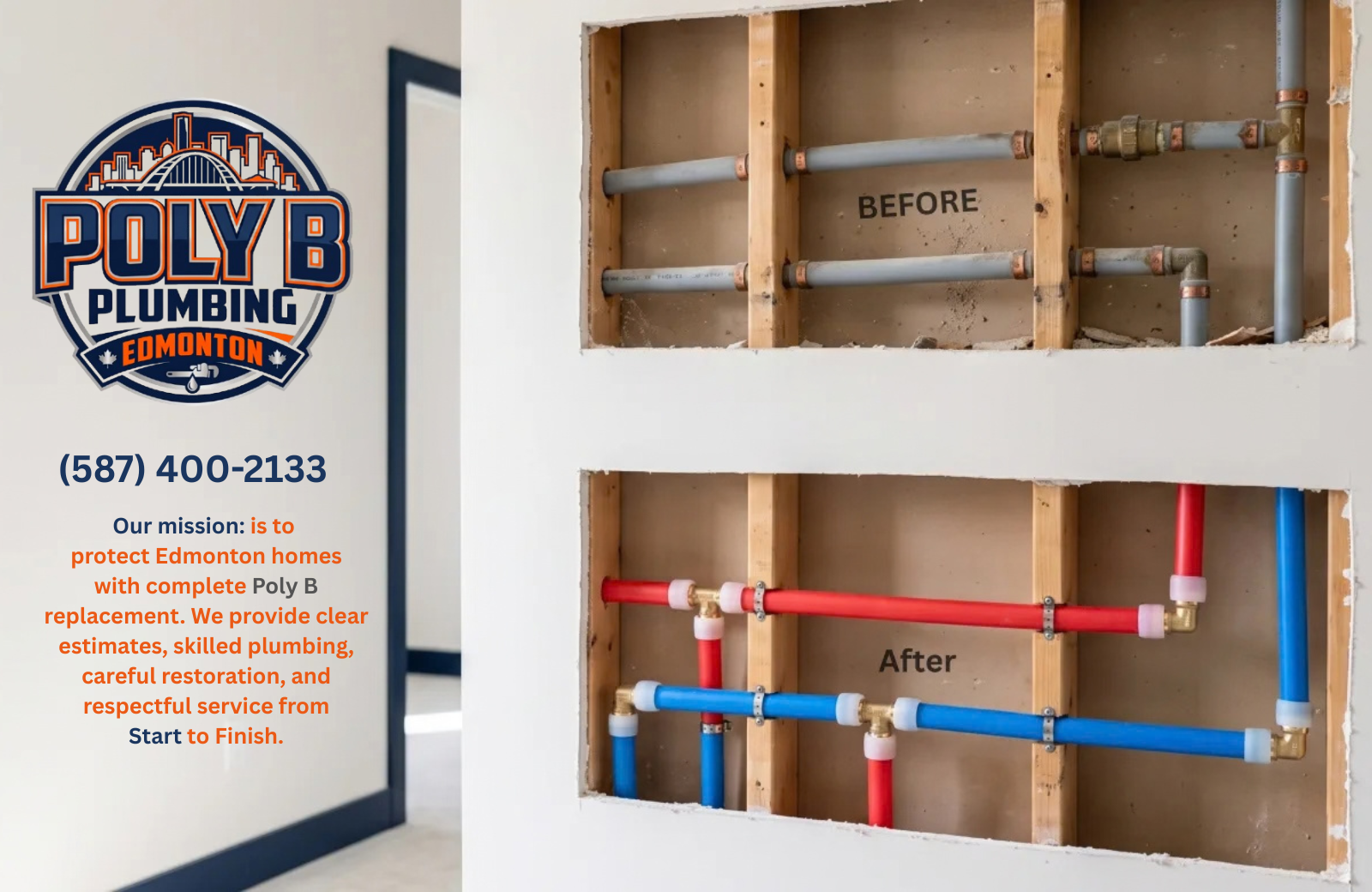
PEX is one commonly considered replacement material for residential water-distribution systems.
PEX is flexible, lightweight, widely used, and available in different sizes.
The appropriate replacement material should be selected based on the home’s design, plumbing requirements, applicable requirements, and project scope.
What Happens During Poly B Replacement?
A professional Poly B replacement project typically begins with an inspection.
Step 1: Inspect the Plumbing
The contractor identifies accessible Poly B and determines how much of the system appears to remain.
Step 2: Plan the Replacement
The plumbing layout is reviewed to determine the best routing for the replacement system.
Step 3: Protect the Home
Flooring, cabinets, furniture, and finished areas are protected before work begins.
Step 4: Create Access
Some plumbing is accessible from unfinished areas.
Other sections may require access through drywall, ceilings, cabinets, or other finished areas.
Step 5: Remove Poly B
The existing Poly B is removed from the areas included in the project.
Step 6: Install Replacement Plumbing
New piping, such as PEX where appropriate, is installed according to the planned layout.
Step 7: Test the System
The new plumbing system is tested before the project is completed.
Step 8: Restore the Home
Where required, drywall, paint, and texture can be repaired.
This approach allows homeowners to address both the plumbing and the finished areas affected by the project.
How Much Does Poly B Replacement Cost in Edmonton?
The cost of replacing Poly B varies from home to home.
There is no reliable one-price-fits-all answer.
Factors that can affect the cost include:
- Home size
- Number of bathrooms
- Number of fixtures
- Number of floors
- Amount of Poly B
- Plumbing layout
- Accessibility
- Finished ceilings
- Finished walls
- Flooring
- Cabinets
- Drywall repairs
- Paint restoration
- Texture restoration
An unfinished basement can provide much easier plumbing access than a home where most plumbing is concealed behind finished walls and ceilings.
The best way to determine the cost of your project is with an in-home estimate.
Poly B Failure Rate and Home Insurance
Insurance requirements can vary between providers and individual properties.
If your home contains Poly B, speak directly with your insurance provider about your specific situation.
Do not assume that one insurance company’s requirements are the same as another company’s.
If you replace the plumbing, keep documentation such as invoices, scope of work, completion documentation, applicable permits, and warranty information.
Good records can be helpful when selling your home or discussing the plumbing system with your insurer.
Should You Buy a Home With Poly B?
Finding Poly B during a home inspection does not automatically mean you should walk away from the property.
Instead, determine the scope of the plumbing system.
Ask:
- How much Poly B is present?
- Where is it located?
- Has some of it already been replaced?
- Is PEX already present?
- What fittings are installed?
- How accessible is the plumbing?
- What would replacement cost?
- What does the insurance provider require?
Having a professional estimate before making a decision can give you a better understanding of the potential project.
Should You Sell a Home With Poly B?
You can sell a home that contains Poly B.
However, potential buyers may have questions about the plumbing system.
A seller who understands the condition and scope of the plumbing can be better prepared to answer questions and provide documentation.
Some homeowners choose to replace Poly B before selling, while others provide information and an estimate to prospective buyers.
The best approach depends on the property and the homeowner’s circumstances.
Poly B Failure Rate: The Bottom Line
So, what is the Poly B failure rate?
There is no single scientifically reliable percentage that can predict failure for every Poly B plumbing system.
Claims that Poly B has a guaranteed 100% failure rate should be treated cautiously.
At the same time, Poly B has a documented history of failures, and its use has been discontinued.
For Edmonton homeowners, the important question is not simply how many Poly B systems will fail.
The better questions are:
How old is my plumbing?
What type of Poly B system do I have?
What fittings were used?
How much Poly B remains?
Where is it located?
What is the condition of the accessible plumbing?
What would replacement cost?
What does my insurance provider require?
Understanding these factors can give you much more useful information than relying on a generic failure percentage.
Frequently Asked Questions About Poly B Failure Rate
What is the Poly B failure rate?
There is no reliable universal percentage that applies to every Poly B installation. Failure risk varies depending on factors such as age, installation, fittings, temperature, pressure, and water conditions.
Is the Poly B failure rate really 100%?
There is no reliable evidence establishing that 100% of all Poly B installations will fail. Some industry sources use 100% as a way of describing Poly B as a non-permanent long-term system, but it should not be treated as a universal statistical failure rate.
How long does Poly B last?
There is no guaranteed lifespan for every Poly B system. Different installations can experience very different outcomes depending on materials, installation, environment, and operating conditions.
Can Poly B last 30 years?
Yes, some Poly B systems have remained in service for decades without a major failure. That does not necessarily mean the system has no risk.
Does Poly B fail suddenly?
A plumbing failure can sometimes occur unexpectedly, particularly when much of the system is hidden. Visible leaks, stains, or fitting problems can sometimes provide warning signs.
Is Poly B dangerous?
The primary homeowner concern with Poly B is the potential for plumbing failure and resulting water damage.
Does all Poly B need to be replaced?
The appropriate decision depends on the specific home, plumbing condition, installation, insurance requirements, and homeowner circumstances. A professional assessment can help determine the available options.
Is PEX a replacement for Poly B?
PEX is one modern material commonly considered for residential water-distribution replacement projects.
Can I insure a home with Poly B?
Insurance requirements vary by provider. Contact your insurance company directly for requirements specific to your home.
Does Edmonton have a high Poly B failure rate?
There is not enough reliable evidence to assign a single failure percentage specifically to Edmonton homes. Alberta-specific information should be considered rather than applying statistics from other regions.
Get Your Free Poly B Assessment in Edmonton
If you are searching for the Poly B failure rate because you discovered grey flexible piping in your home, the best first step is to identify what you actually have.
Poly B Plumbing Edmonton specializes in Poly B identification, removal, replacement, and complete plumbing remediation for homeowners, condos, apartments, and multi-unit properties throughout Edmonton.
Our services include:
- Poly B identification
- Plumbing assessment
- Complete Poly B removal
- PEX repiping
- Floor protection
- Drywall repairs
- Paint and texture restoration
- Complete plumbing remediation
We can inspect your accessible plumbing, explain your options, and provide a free, no-obligation in-home estimate for your Poly B replacement project.
Book Your Free In-Home Estimate
Poly B Plumbing Edmonton
Phone: (587) 400-2133
Website: polybplumbingedmonton.ca
Protect It. Replace It. Restore It.