A Complete Homeowner’s Guide:
If you’re wondering How to Identify Poly B Piping in Your Home, you’re not alone.
Additionally, thousands of homes across Edmonton and Alberta were built with polybutylene plumbing.
This installation is commonly called Poly B.
It was used particularly in homes constructed during the 1980s and 1990s.
How to Identify Poly B Piping in Your Home can be challenging.
Additionally, much of the plumbing sits behind drywall, ceilings, and floors.
Finished areas conceal it and complicate detection.
How to Identify Poly B Piping in Your Home is important when you’re buying an older home.
Moreover, knowing this helps you assess a property’s renovation needs, sellability, insurance, and plumbing type.
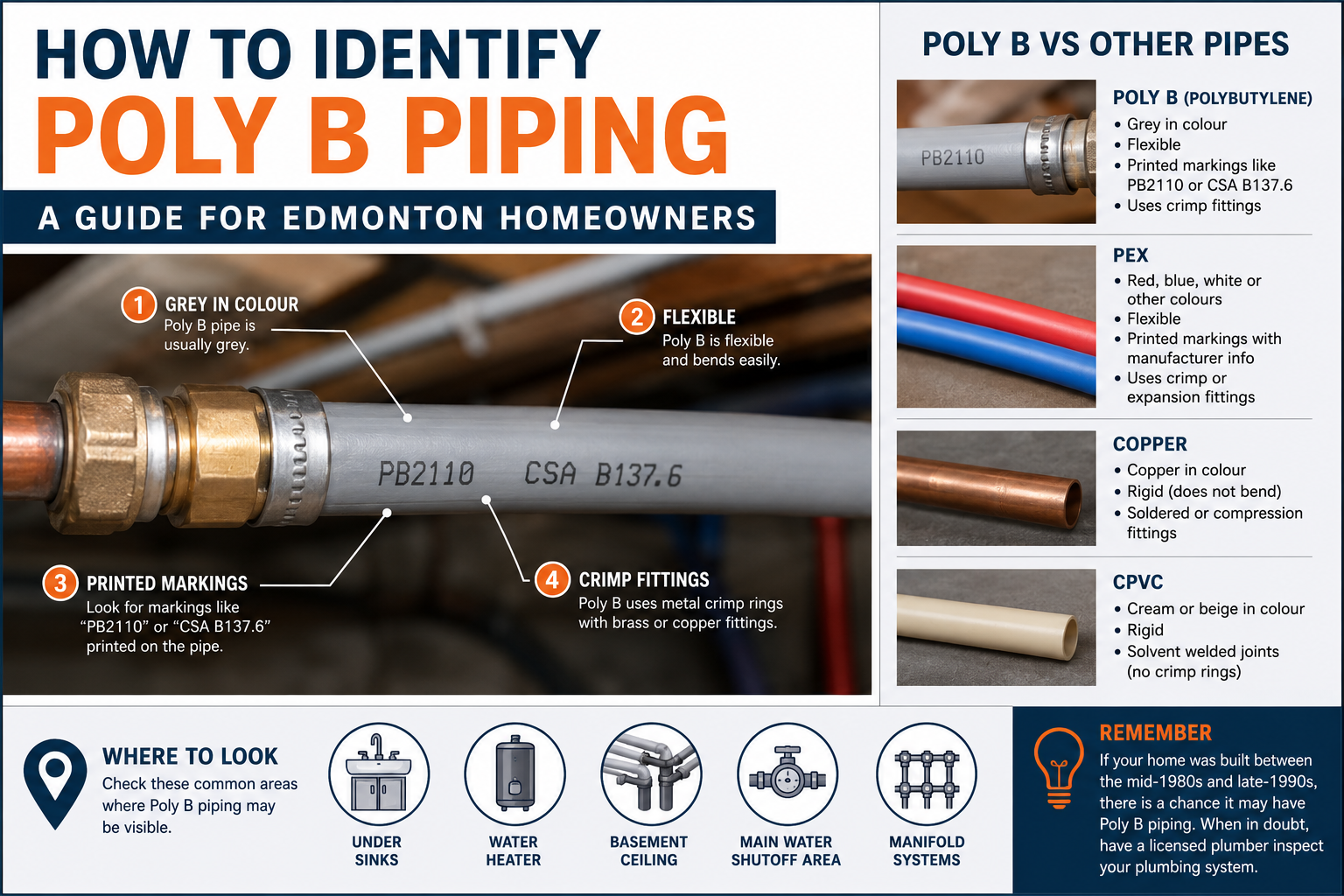
This guide explains How to Identify Poly B Piping in Your Home and what Poly B looks like. Additionally, it covers where to look for it and how to distinguish it from PEX and other materials. It also explains the pipe markings, partial replacement signs, and what to do if Poly B is discovered.
What Is Poly B Piping?
Poly B is short for polybutylene, a type of flexible plastic piping that was widely used for residential potable-water supply systems.
Unlike PVC drain piping, Poly B was designed to carry pressurized hot and cold water throughout a home. It was flexible, relatively inexpensive, and faster to install than traditional copper plumbing.
Many Canadian homes constructed during the 1980s and 1990s used Poly B for their water distribution systems.
The problem for today’s homeowners is that much of this plumbing is now several decades old.
That means a homeowner who purchases a house built in the 1980s or 1990s may inherit a plumbing system that they never knew existed.
Before worrying about replacement, however, the first step is simple:
Find out what type of plumbing you actually have.
And that starts with knowing how to identify Poly B piping.
How to Identify Poly B Piping
There are several characteristics that can help you identify Poly B.
You should look at:
- The color of the pipe
- The flexibility of the pipe
- The markings printed on the pipe
- The type of fittings being used
- The age of the home
- Where the pipe is located
- Whether the plumbing has been partially replaced
- Whether the pipe connects to a manifold
- Whether the system contains copper, PEX or other materials
No single characteristic should necessarily be used by itself to make a final determination.
Instead, look for several identifying characteristics together.
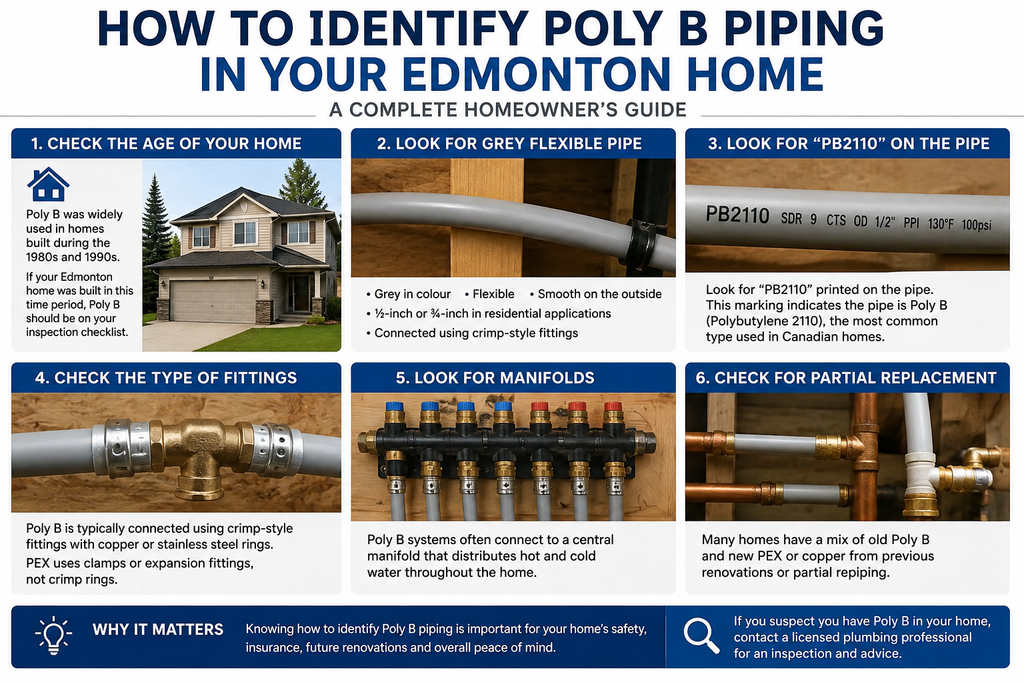
1. Check the Age of Your Edmonton Home
One of the easiest ways to determine whether your home might contain Poly B is to check when it was built.
If your Edmonton-area home was constructed during the 1980s or 1990s, Poly B should be on your inspection checklist.
That doesn’t automatically mean the home has Poly B.
Likewise, a newer home may contain sections of older plumbing if renovations or additions were completed using existing materials.
However, the construction date gives you an excellent starting point.
Homes worth investigating include:
- Homes built during the 1980s
- Homes built during the early 1990s
- Homes built during the mid-1990s
- Homes built toward the late 1990s
- Homes that have undergone plumbing renovations
- Homes where previous owners have completed partial repiping
If you are purchasing an older Edmonton property, ask your home inspector specifically to identify the plumbing material.
A standard home inspection may identify Poly B, but homeowners should understand exactly what material was found and how much of the system appears to remain.
2. Look for Grey Flexible Pipe
One of the most recognizable characteristics of Poly B is its appearance.
Poly B is commonly gray in color.
The pipe is also flexible.
If you find a gray plastic water-supply pipe that can flex relatively easily, you may be looking at Poly B.
This is one of the easiest visual clues when learning how to identify Poly B piping.
However, color alone isn’t enough.
Modern plumbing products can come in different colors, and older Poly B installations may have been modified over the years.
Look at the pipe markings and fittings as well.
Poly B commonly appears:
- Grey
- Flexible
- Smooth on the outside
- Approximately ½-inch or ¾-inch in residential applications
- Connected using crimp-style fittings
If you find gray flexible piping in your basement, under a sink or near your water heater, take a closer look before assuming it is PEX.
3. Look for “PB2110” on the Pipe
One of the most useful ways to determine how to identify Poly B piping is to inspect the writing printed along the pipe.
Polybutylene pipe may contain markings identifying the material and manufacturing specifications.
One important marking homeowners may encounter is:
PB2110
If you find PB2110 printed repeatedly along gray flexible plumbing pipe, that’s a strong indication that you’re looking at polybutylene piping.
The markings may be:
- Faded
- Difficult to read
- Covered by insulation
- Hidden behind fittings
- Facing the wall or floor
- Partially visible
Don’t assume the pipe isn’t Poly B simply because you cannot find the marking.
The writing can disappear over time or be located in an inaccessible portion of the pipe.
If you’re unsure, take clear photographs of the pipe and fittings and have a qualified plumbing professional identify the material.
4. Examine the Fittings
The fittings can provide another major clue.
Poly B systems commonly used fittings connected to the pipe using crimp rings.
When examining an exposed section, look for a connection where the flexible gray pipe enters a fitting and is secured with a metal crimp ring.
Depending on the original installation, you may encounter different fitting materials and configurations.
You may see:
- Copper fittings
- Brass fittings
- Metal crimp rings
- Plastic fittings in some installations
- Manifold connections
The fitting itself isn’t enough to prove that a system is Poly B.
But when you combine gray flexible pipe + crimp fittings + PB2110 markings + an older construction date, the evidence becomes much stronger.
5. Check Under Your Kitchen and Bathroom Sinks
If you want to know how to identify Poly B piping without cutting into your walls, start with accessible plumbing.
Open the cabinet underneath your kitchen sink.
Look at the plumbing entering the shut-off valves.
You may see newer braided stainless-steel supply lines connected to the faucet. That’s not necessarily the pipe feeding the fixture inside your walls.
Look farther back toward the wall.
The plumbing entering the shut-off valve may reveal the material used throughout the house.
Do the same thing under:
- Bathroom sinks
- Basement sinks
- Laundry sinks
- Utility sinks
Remember that a homeowner may have replaced the final section of plumbing while leaving Poly B inside the walls.
6. Check Around Your Water Heater
Your water heater is another excellent inspection point.
Look at the water lines entering and leaving the tank.
Depending on the home’s plumbing configuration, you may find an exposed section of the original water-supply piping.
This area can be particularly useful because the plumbing is often visible in a mechanical room or unfinished basement.
Take a photograph of:
- The pipe
- The fittings
- Any printed markings
- The connection to other plumbing materials
Don’t bend, pull or manipulate an old pipe just to inspect it.
If the material is questionable, leave it alone and have it professionally evaluated.
7. Check Your Basement Ceiling
If your Edmonton home has an unfinished basement, you may have one of the best opportunities to determine whether Poly B is present.
Look between the floor joists.
You may see multiple flexible pipes running toward:
- Bathrooms
- Kitchens
- Laundry rooms
- Exterior hose connections
- Basement fixtures
- Water heaters
If those lines are gray and flexible, inspect them for identifying markings.
An unfinished basement can also help determine whether the entire house is still plumbed with Poly B or whether previous owners have replaced portions of the system.
Poly B vs PEX: How Can You Tell the Difference?
One of the most common questions homeowners ask is:
“Is my gray pipe Poly B or PEX?”
This is an important question because the two materials can be confused.
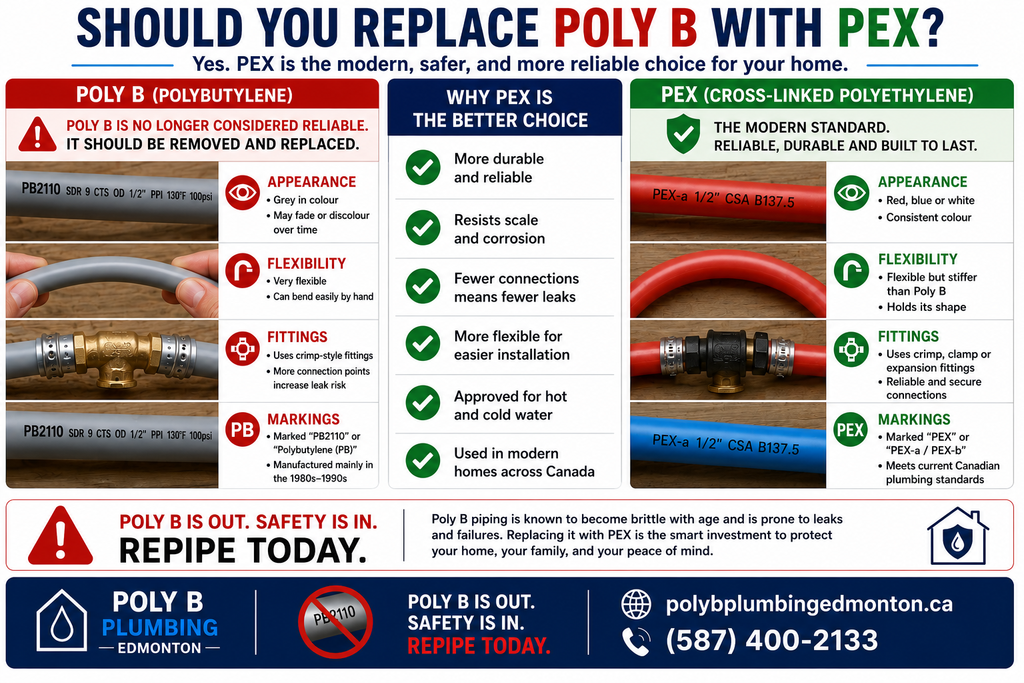
Poly B
Poly B is commonly:
- Grey
- Flexible
- Found in older homes
- Marked with identifying material codes
- Connected using older-style fittings and crimp rings
PEX
PEX is modern cross-linked polyethylene tubing.
It commonly appears in:
- Red
- Blue
- White
- Black
- Other colors depending on manufacturer
PEX also typically has extensive printing along the tubing identifying the manufacturer, size, pressure rating and applicable standards.
However, gray PEX also exists.
That’s why simply seeing gray tubing doesn’t automatically mean Poly B.
This is one reason homeowners should inspect the markings rather than relying solely on color.
Poly B vs Copper
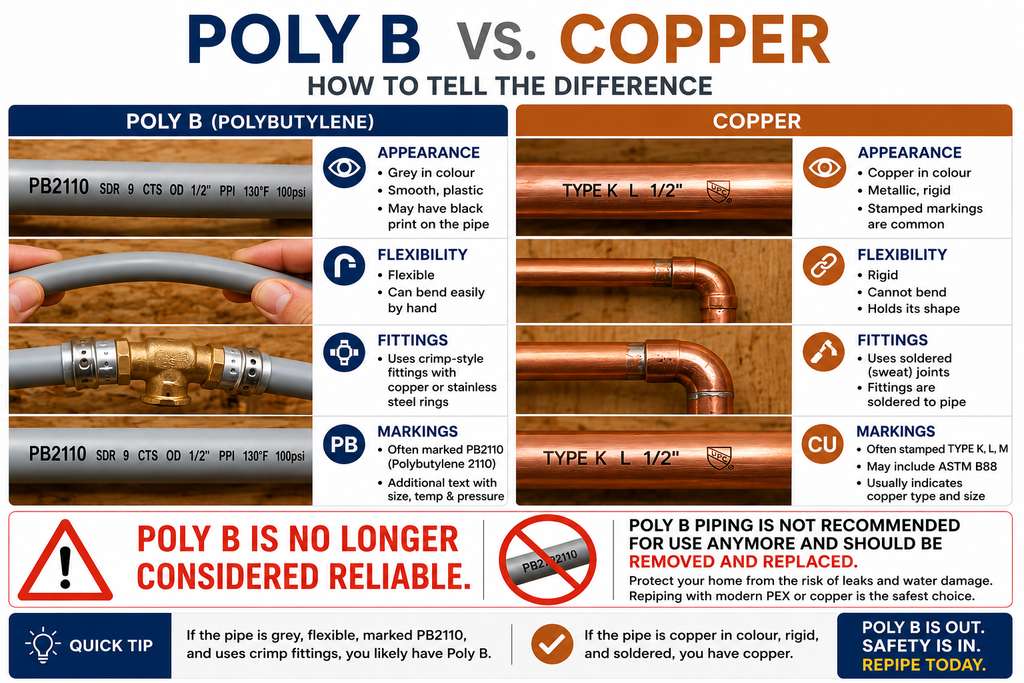
Copper is much easier to distinguish.
Copper is metallic and typically has a reddish-brown appearance.
It is rigid and doesn’t bend like flexible plastic tubing.
Copper systems may have:
- Soldered joints
- Compression fittings
- Threaded connections
- Rigid pipe sections
If your home has copper supply piping, you won’t generally be able to bend the pipe by hand like flexible Poly B.
However, some homes contain a combination of copper and Poly B.
A previous owner may have replaced only certain sections.
Poly B vs CPVC
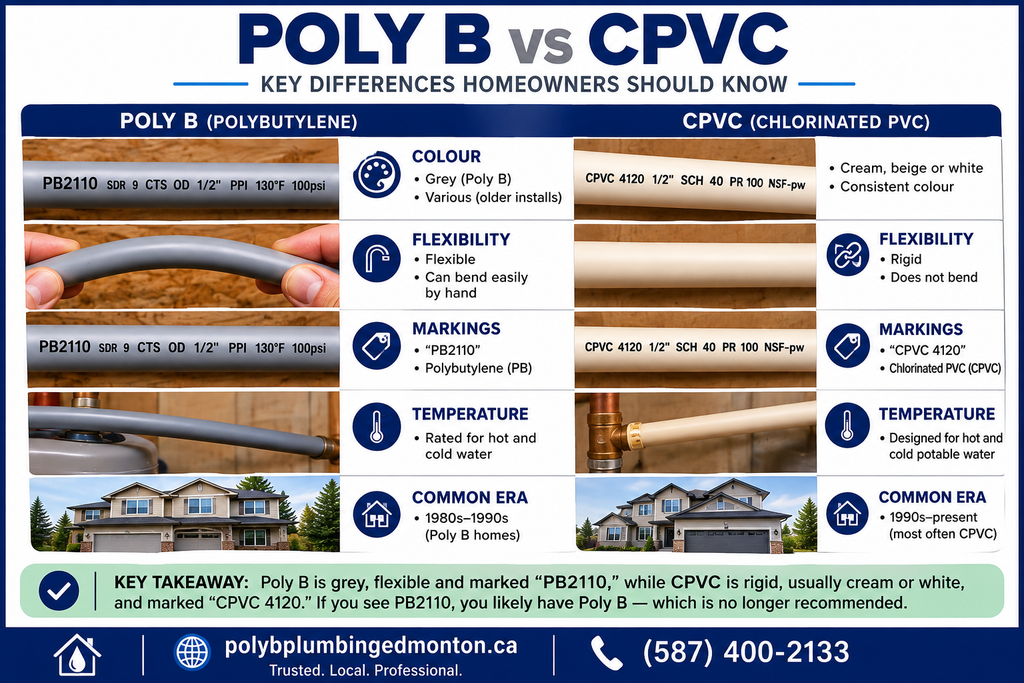
CPVC is another material that can appear in older homes.
CPVC is generally:
- Cream
- Beige
- Yellowish
- Rigid
It is not normally flexible like Poly B.
CPVC connections are also different from typical Poly B crimp connections.
If you’re looking at a rigid cream-colored plastic pipe, you’re probably looking at something other than Poly B.
Where Else Can You Find Poly B?
If your initial inspection doesn’t reveal anything, check additional locations.
Look at:
- Basement utility rooms
- Mechanical rooms
- Laundry rooms
- Behind accessible bathroom cabinets
- Under kitchen cabinets
- Near the main water shutoff
- Around the water meter
- Around the water heater
- Unfinished basement ceilings
- Crawlspaces
- Exposed ceiling areas
- Around exterior hose bibs
- Plumbing manifolds
You don’t need to inspect every inch of plumbing yourself.
The goal is to find enough visible information to determine whether further professional investigation is warranted.
What If You Find Both Poly B and PEX?
This is extremely common.
A homeowner may discover red and blue PEX in one bathroom while finding gray Poly B in the basement.
That doesn’t necessarily mean the entire house has been re-piped.
A previous owner may have replaced plumbing during:
- Bathroom renovations
- Kitchen renovations
- Water heater replacement
- Plumbing repairs
- Basement development
- Fixture replacements
- Leak repairs
This creates an important question:
How much Poly B is actually left?
A single bathroom being re-piped does not necessarily mean the entire home’s plumbing has been replaced.
If your objective is complete Poly B remediation, the entire potable-water distribution system needs to be evaluated.
Why Partial Poly B Replacement Can Be Misleading
One of the biggest mistakes homeowners make is seeing modern PEX under one sink and assuming the entire home has been re-piped.
Imagine this:
The previous owner renovated the main bathroom.
The walls were opened.
The plumber replaced the plumbing in that bathroom with PEX.
The rest of the house remained unchanged.
Five years later, you purchase the property.
You look under the bathroom sink and see PEX.
You assume the plumbing has been upgraded.
Meanwhile, gray Poly B is still running throughout the basement ceiling and inside the walls.
This is why knowing how to identify Poly B piping throughout the home is more important than checking one fixture.
Case Study: An Edmonton Home Inspection
Consider a typical Edmonton home built in the 1990s.
The buyer’s inspection reveals gray flexible plumbing underneath the basement ceiling.
The buyer initially assumes it is PEX because the home has already had renovations.
After inspecting the accessible sections, they discover:
- Grey flexible supply piping
- Older crimp-style fittings
- Polybutylene markings
- PEX in one renovated bathroom
- Poly B supplying other fixtures
The lesson is simple:
A renovated bathroom does not necessarily mean the entire plumbing system has been replaced.
Before negotiating a purchase price or assuming that replacement isn’t necessary, determine how much original piping remains.
Case Study: Selling a Home With Poly B
Poly B can also become a consideration when selling an Edmonton property.
A buyer may identify Poly B during their home inspection and request:
- A price reduction
- A repair
- A replacement
- A credit
- Additional documentation
- A professional assessment
This can turn a plumbing system that was barely noticed by the seller into a major part of the real-estate negotiation.
If you’re planning to sell a home with Poly B, getting a professional assessment before listing can help you understand what you’re dealing with.
You may be able to address the issue proactively rather than waiting for the buyer’s inspection.
Case Study: Poly B Discovered Before Moving In
Another common situation occurs when a buyer discovers Poly B after making an offer.
Instead of waiting until after possession, the buyer obtains a replacement quote and negotiates with the seller.
This can sometimes allow the replacement to happen while the house is vacant.
That has an important advantage.
Opening walls, accessing ceilings and repairing drywall is much easier when the home isn’t fully occupied.
If you’re purchasing a home with Poly B, consider obtaining a replacement estimate before your purchase conditions expire.
Does Poly B Always Fail?
No plumbing material should be treated as if failure can be predicted to an exact date.
Some homes have had Poly B for decades without experiencing a major leak.
Other homes have experienced failures much earlier.
The fact that a home has never had a leak does not prove that the plumbing will never have a problem.
Likewise, finding Poly B doesn’t mean a homeowner should panic.
The appropriate response is to understand the condition of the system and make an informed decision.
A qualified professional can help determine the scope of the plumbing and explain the replacement options available for your specific home.
Why Edmonton Homeowners Should Take Poly B Seriously
Edmonton homes containing Poly B are now dealing with plumbing systems that can be several decades old.
That makes identification increasingly important.
Even if your insurance company currently provides coverage, policies and underwriting requirements can change.
A homeowner may also want to consider the potential cost of water damage.
A plumbing failure can affect more than the pipe itself.
Depending on where a failure occurs, water can damage:
- Drywall
- Flooring
- Cabinets
- Insulation
- Electrical components
- Ceilings
- Finished basements
- Furniture
- Personal belongings
The cost of repairing the plumbing may be only one part of a much larger water-damage claim.
What Should You Do If You Find Poly B?
If you’ve followed this guide and believe you have Poly B, don’t start cutting into walls yourself.
Instead:
Step 1: Photograph the plumbing
Take clear pictures of:
- The pipe
- Markings
- Fittings
- Main water entry
- Water heater connections
- Exposed basement runs
Step 2: Document where you found it
Make a simple list of the areas where Poly B appears.
For example:
- Basement
- Kitchen
- Main bathroom
- Ensuite
- Laundry room
- Exterior hose bibs
Step 3: Check whether renovations were completed
Ask previous owners, if possible, whether any plumbing was replaced.
Step 4: Contact a Poly-B specialist
Have the plumbing system evaluated by someone experienced with Poly B replacement.
Step 5: Get a written scope and quote
A professional assessment should help you understand:
- How much Poly B remains
- Where it is located
- What needs to be accessed
- What replacement material will be used
- What restoration work may be required
- The expected project cost
Should You Replace Poly B With PEX?
For homeowners choosing to remove Poly B, PEX is one of the common modern replacement options.
PEX is flexible, durable and widely used in residential plumbing systems.
The specific type of PEX and installation method should be selected by a qualified plumbing professional based on the home’s layout, applicable plumbing requirements and project scope.
A proper replacement isn’t simply about pulling out visible gray pipe.
The goal is to create a reliable new water distribution system throughout the home.
For more information about replacement, see our guide to Poly B replacement in Edmonton.
How Much Does Poly B Replacement Cost in Edmonton?
There isn’t one universal price.
Every home is different.
The cost can depend on:
- Home size
- Number of bathrooms
- Number of fixtures
- Number of floors
- Basement configuration
- Accessibility
- Location of plumbing
- Amount of drywall removal
- Ceiling access
- Flooring
- Kitchen cabinets
- Plumbing layout
- Whether restoration is included
- Whether the homeowner handles some restoration work
A two-story home with three bathrooms and finished ceilings can require considerably more access work than a bungalow with an unfinished basement.
That’s why online estimates should be treated as general information rather than a quote for your property.
The best way to understand the cost is to have your home assessed.
Poly B and Home Insurance
Insurance is another reason homeowners search how to identify Poly B piping.
Insurance requirements can vary between companies and individual policies.
Some insurers may have specific requirements concerning Poly B.
Others may request documentation or evidence of remediation.
If you’re buying a home, don’t assume that the seller’s current insurance situation automatically means you will receive identical coverage.
Speak directly with your insurance provider and ask about the specific property.
If replacement is required, keep your documentation, invoices, permits where applicable and completion information.
What About a Leak Detection System?
If you aren’t immediately replacing the plumbing, some homeowners consider installing a whole-home water monitoring and automatic shutoff system.
These devices can monitor water usage and, depending on the system, detect unusual flow patterns and shut off the home’s main water supply.
A monitoring device doesn’t repair Poly B and shouldn’t be considered a replacement for addressing an aging plumbing system.
However, it may provide an additional layer of protection against certain types of water-loss events.
For more information about leak detection and water-loss prevention, homeowners can research products and independent testing information before choosing a system.
Frequently Asked Questions About Identifying Poly B
How can I tell if my house has Poly B?
Look for gray, flexible plastic water-supply pipe, particularly in homes constructed during the 1980s and 1990s. Inspect accessible plumbing for markings such as PB2110 and examine the fittings. If you’re uncertain, have a qualified plumber confirm the material.
What color is Poly B pipe?
Poly B is most commonly gray. However, color alone isn’t enough to positively identify the material because other plastic plumbing products can also be gray.
What does PB2110 mean?
PB2110 is an identifying designation associated with polybutylene pipe. If you see PB2110 printed on flexible gray water-supply tubing, have the material professionally confirmed.
Is gray PEX the same as Poly B?
No. Grey PEX and gray Poly B are different materials. This is why homeowners shouldn’t identify plumbing based solely on color. Look at the markings, fittings, age and overall installation.
Can Poly B be connected to PEX?
Yes, appropriate transition fittings and installation methods can be used when transitioning between older Poly B piping and modern plumbing materials. The connection should be completed using fittings suitable for the specific materials involved.
Does seeing PEX mean my house has been completely re-piped?
No. A home can contain both PEX and Poly B. A bathroom or kitchen renovation may have replaced only a portion of the plumbing.
Do I need to remove my walls to identify Poly B?
Not necessarily. Many homes have accessible sections of plumbing in basements, utility rooms, under sinks and around mechanical equipment. A professional can determine whether additional investigation is necessary.
Should I replace Poly B if it hasn’t leaked?
There isn’t a universal answer for every homeowner. The decision should consider the condition and age of the system, insurance requirements, your risk tolerance, the home’s value and the potential cost of a future failure. A professional assessment can help you make an informed decision.
Can a home inspector identify Poly B?
A home inspector can often identify visible Poly B and note it in an inspection report. However, concealed plumbing cannot necessarily be evaluated without opening finished surfaces. If the plumbing system is important to a purchase decision, consider obtaining a specialist assessment.
The Bottom Line: Knowing How to Identify Poly B Piping Matters
Learning how to identify Poly B piping is one of the most useful things an Edmonton homeowner can do if they own or are considering purchasing an older home.
Start with the home’s construction date.
Then inspect accessible plumbing.
Look for gray flexible tubing.
Check the printed markings.
Examine the fittings.
Compare the material with PEX, copper and CPVC.
Most importantly, don’t assume that seeing a small amount of PEX means the entire home has been re-piped.
If you discover Poly B, you don’t necessarily need to panic. The important thing is to understand what you have, determine how much remains, understand your insurance requirements and obtain professional advice about your options.
Need Help Identifying Poly B in Your Edmonton Home?
Poly B Plumbing Edmonton specializes in Poly-B identification, assessment and replacement for homeowners throughout Edmonton and surrounding communities.
If you’ve discovered gray flexible plumbing during a home inspection, renovation or basement project, our team can help determine whether you’re dealing with Poly B and explain your replacement options.
We offer:
- Free, no-obligation estimates
- Professional Poly-B assessments
- Fixed-price replacement options
- Complete Poly-B replacement
- PEX repiping
- 25-year warranty
- Poly-B Replacement Certificate
- Protection of your home during the project
Don’t guess what’s behind your walls.
Contact Poly B Plumbing Edmonton today for a free estimate and find out exactly what is in your home’s plumbing system.
Helpful Resources & Further Reading
For homeowners researching Poly B, it’s worth reviewing information from independent and authoritative sources in addition to speaking with a plumbing professional at 587-400-2133
Useful resources include:
- Government and municipal building information for applicable plumbing requirements.
- Your home insurance provider for current Poly-B underwriting and coverage requirements.
- Your home inspection report for documentation of visible plumbing materials.
- Independent plumbing and building-science resources for background information about polybutylene piping.
- Canadian Standards Association resources for information relating to plumbing standards and materials.
Always verify current requirements with the appropriate authority or professional because plumbing codes, insurance requirements and manufacturer specifications can change.